
Sports investors make high-stakes decisions in under 5 minutes. They need pitch conditions, player form, toss impact, and win probability, not as raw numbers, but as fast, reasoned insights they can act on immediately. The original product (CRIQ) gave them data. It did not give them decisions.
The result: 50% drop in DAU and over 40% of users took 4+ days to even start a free trial.
Rebuilt the product's information architecture from scratch around how a sports investor's brain actually works during a live match, not around how data was organised internally. Introduced the FIND / DECIDE / TRACK / ENGAGE mental model, redesigned the paywall from a hard gate to a value-first experience, and embedded AI explainability and trust signals throughout every touchpoint.
Part of a 3-person design team. I drove the IA restructure, made the Phase 1 UI direction, owned the paywall strategy, and designed the Info page that became the one of the most adopted page in the product. Collaborated directly with AI/ML teams to surface predictions in contextual, human-readable formats
A sports investor is not a casual fan. They think in odds, probability, and player stats. Before a match they are asking: "Is this a batting match or a bowling match?" After the toss they are asking: "What changed? Who gained the real advantage?"
Our research revealed 4 core traits of this user:
Insight Oriented: they want actionable AI reasoning, not raw numbers. "Math kar ke dimag kharaab ho jaata hai." (Doing the math yourself is exhausting)
Data Accessible: the pre-match window is 5 minutes maximum. If the app is slow or information is missing, they skip it entirely.
Not predictions in isolation: they need the WHY. "Reasoning dikh jaye. Confidence level bhi bataye." (Show me the reasoning. Tell me how confident you are)
Decision Focused: they need fast validation. "Match palat gaya kya? Aur wait karoon ya nikal jaaun?" (Has the match turned? Should I wait or exit now?)
Math kar ke dimag kharaab ho jaata hai
Match palat gaya kya? Aur wait karoon ya nikal jaaun?
Reasoning dikh jaye. Confidence level bhi bataye.
The key insight came from mapping the user's mental model across two distinct time windows
This Pre/Post Toss framework became the foundation for everything. The old IA treated all data as equal. The new IA treated data as time-sensitive and decision-relevant.
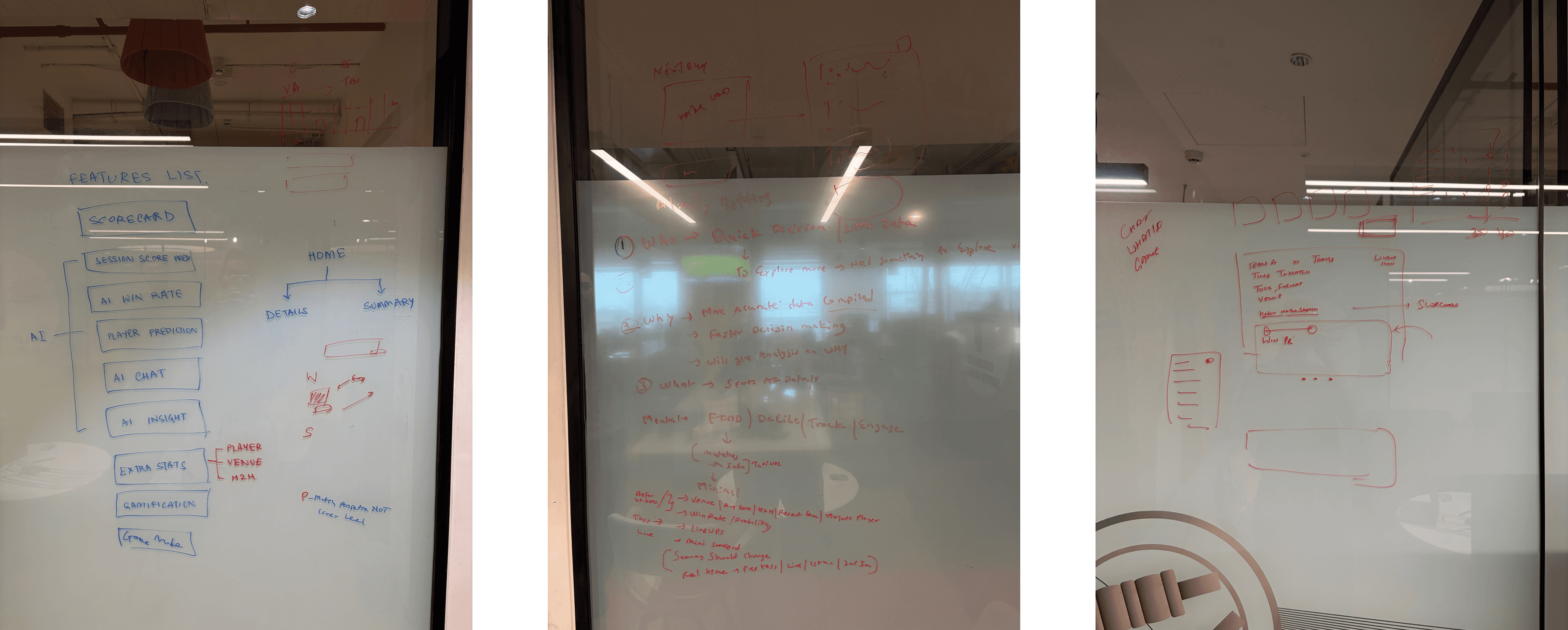
The old IA was organised around how data existed internally, not how users consumed it. Our researcher, building on the team's research, identified the FIND / DECIDE / TRACK / ENGAGE mental model. I took that framework and translated it into the full product IA and UI:
Find
What matches to invest in
Decide
When to enter, how much
Track
Investments, Probability, live scenarios
Engage
News, Stats, Content
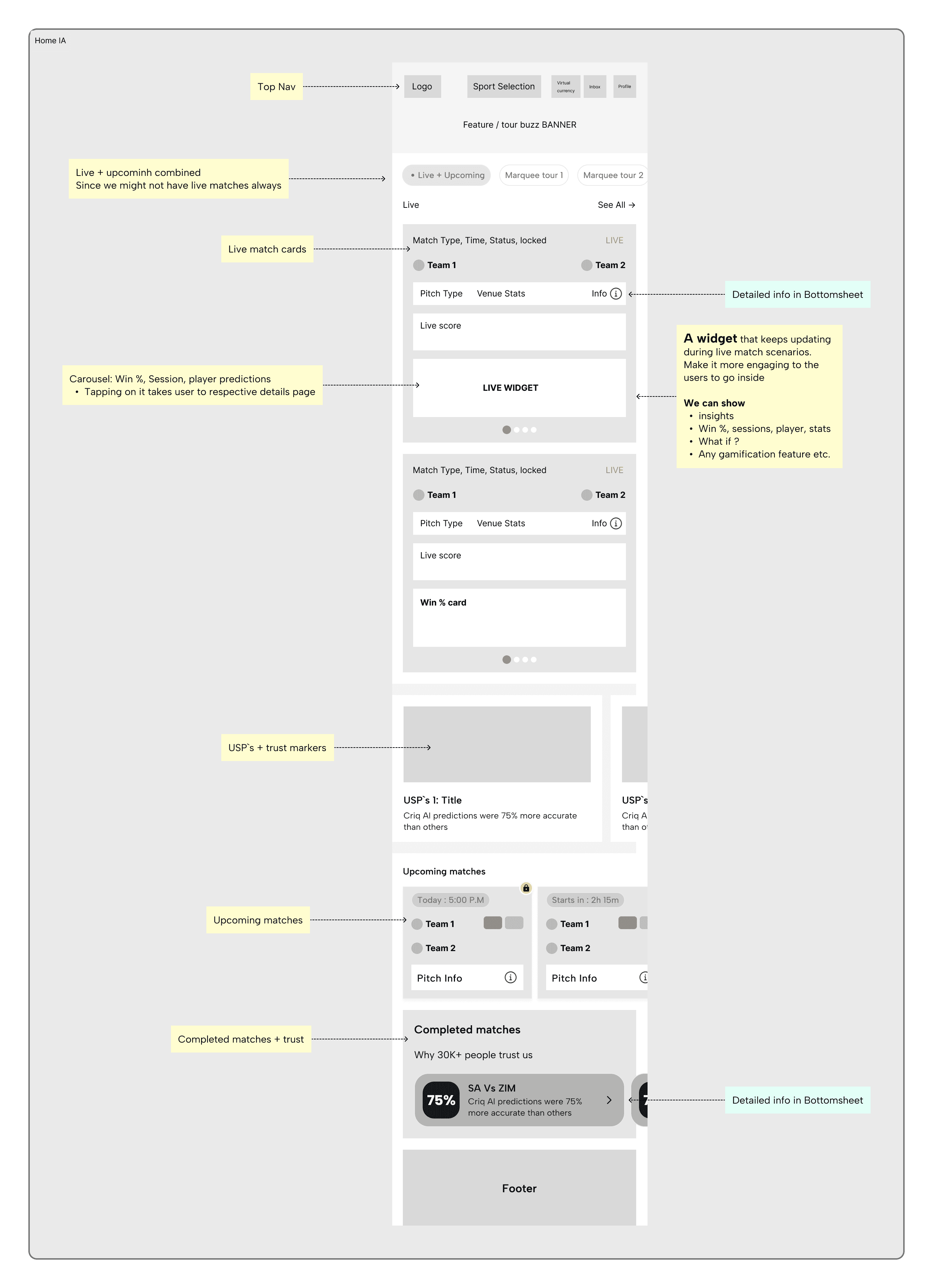
I mapped every single user flow with explicit reasoning for each structural decision, from Login through Home, Live match cards, Match detail, Player predictions, Stats, and the Scorecard. The IA was designed so a user could go from opening the app to making a decision in under 5 minutes.
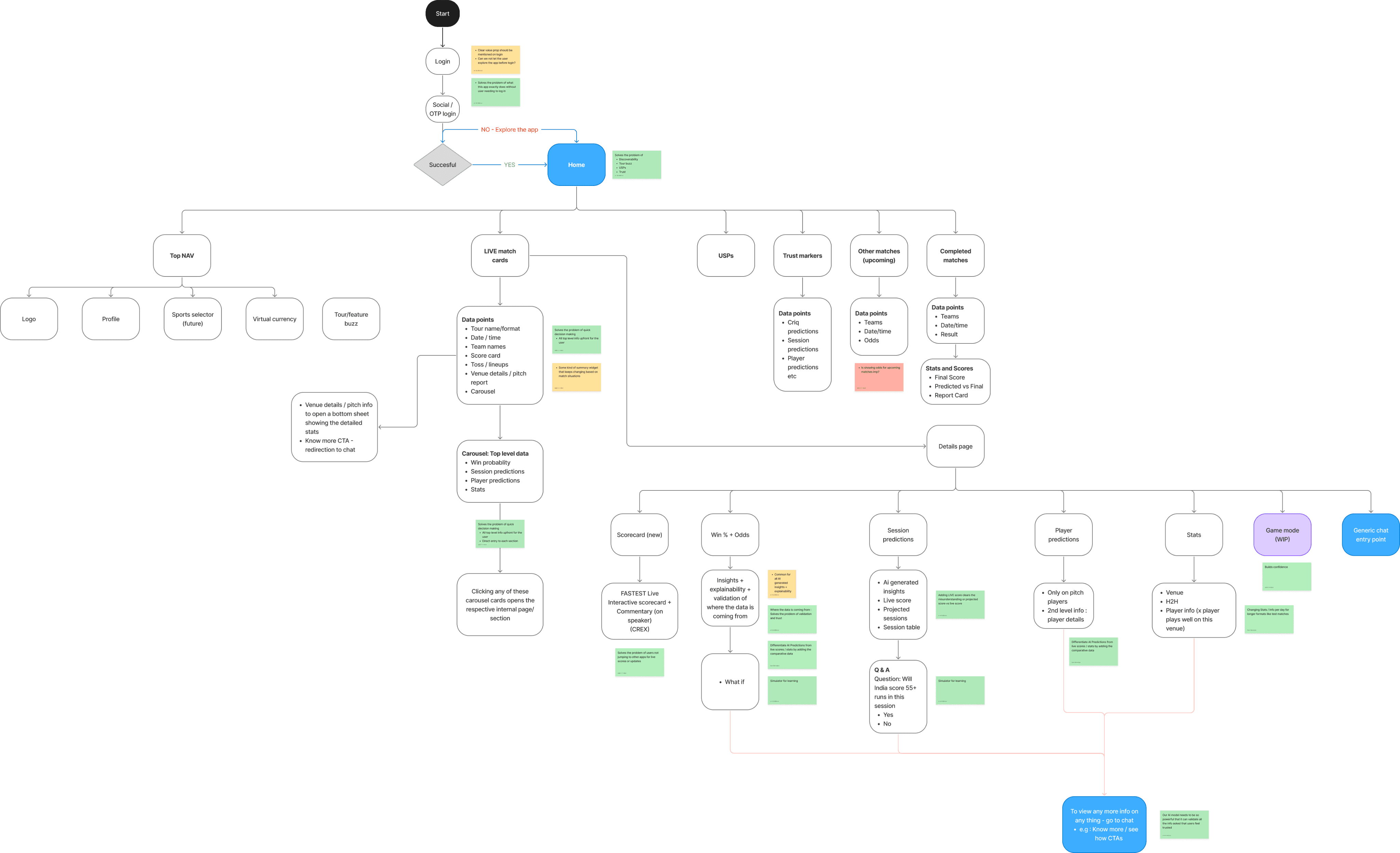
The IA restructure involved multiple rounds of stakeholder alignment over 2 weeks. Once directional consensus was reached, the Phase 1 UI direction was completed in a single night and approved the following day."
Key UI decisions that came from this:
Live and Upcoming combined on home since live matches are not always available.
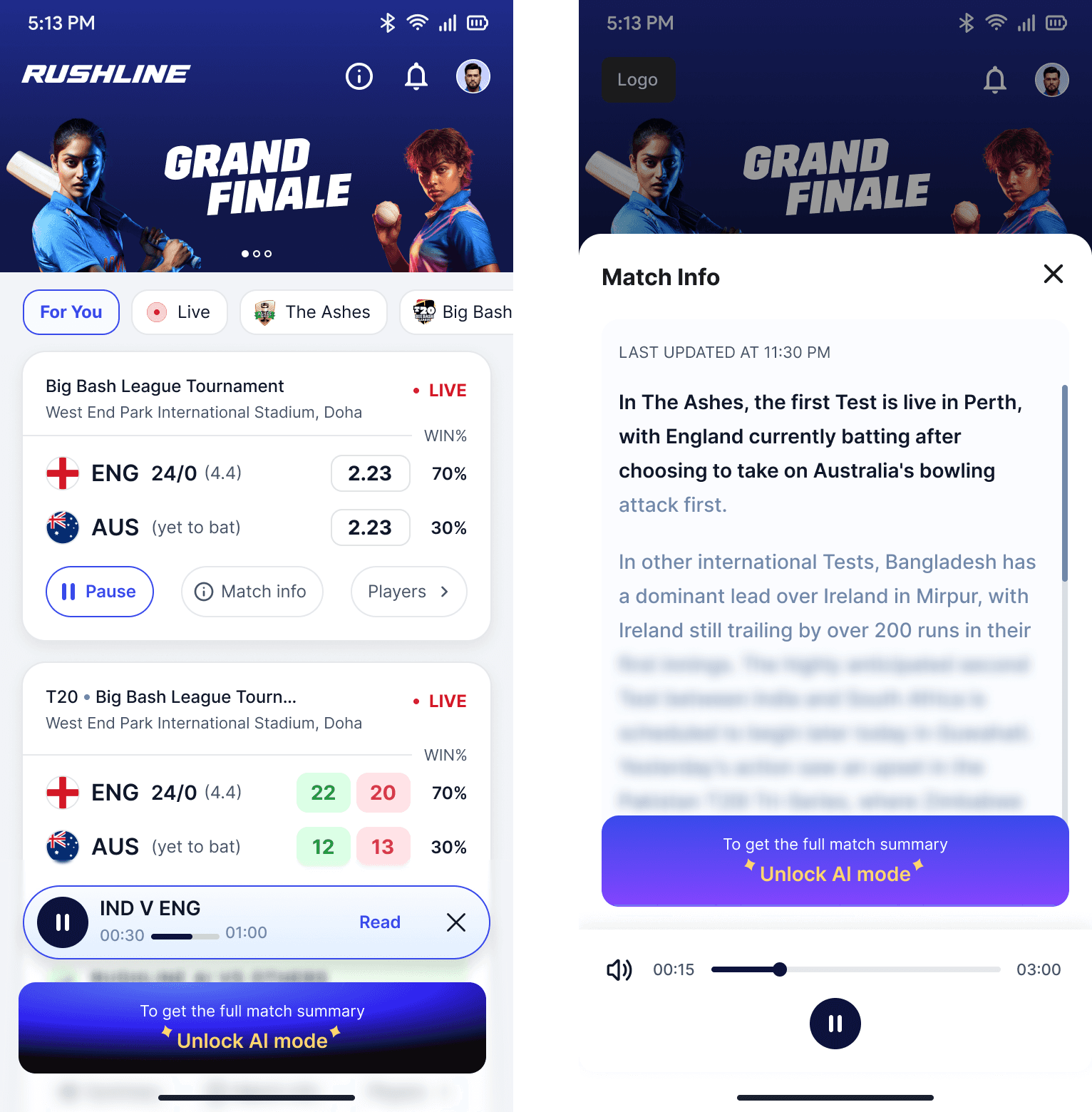
Live Widget carousel surfacing Win%, Sessions, Player predictions at a glance.
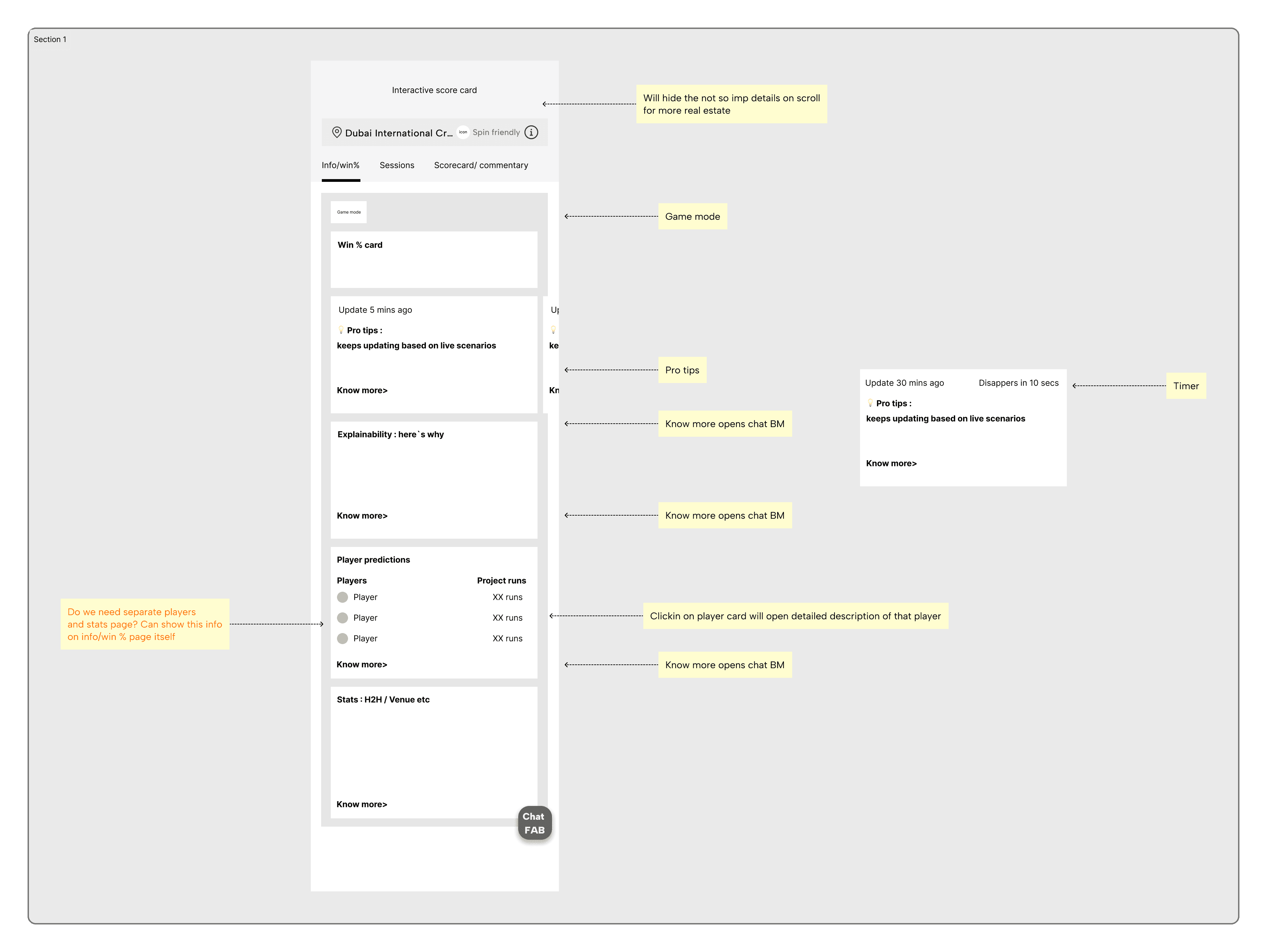
"Know more" consistently opening contextual bottom modals, not new pages.
Pro tips with auto-dismiss timers to create urgency without overwhelming.
Explainability built into every AI prediction so users always see the reasoning.
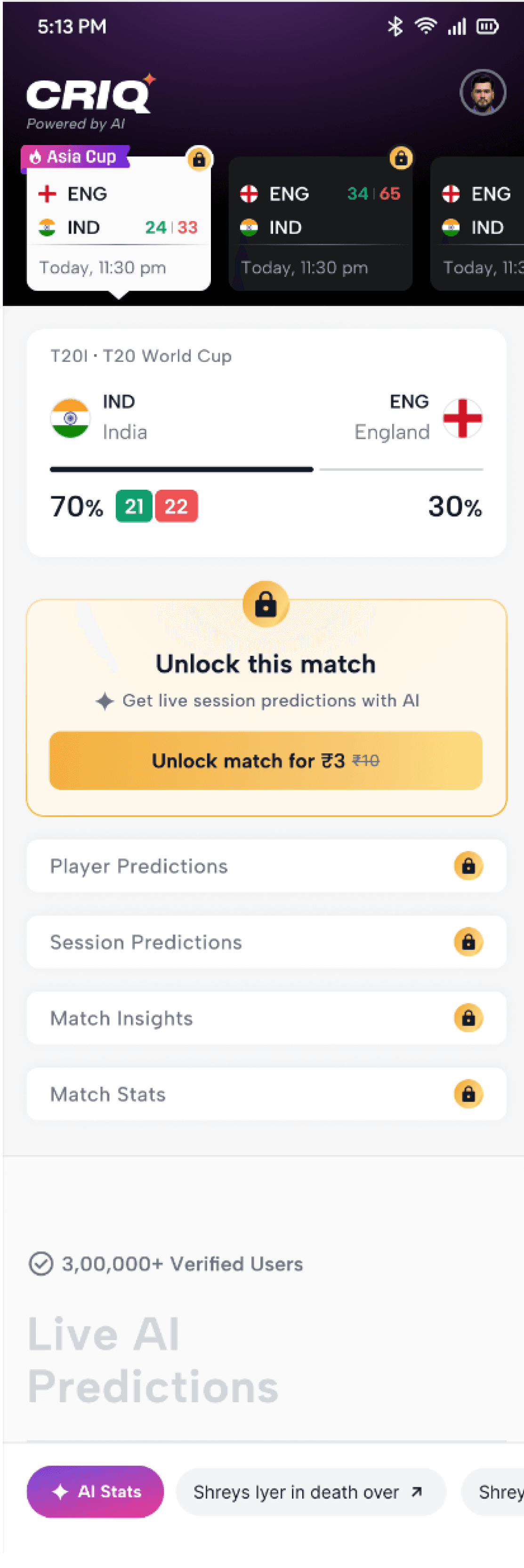
The original CRIQ used a hard paywall. A Match Pass blocked all content behind a payment screen. Users had to pay before seeing any value.
*Rushline was initially called as CRIQ- the paywall screens
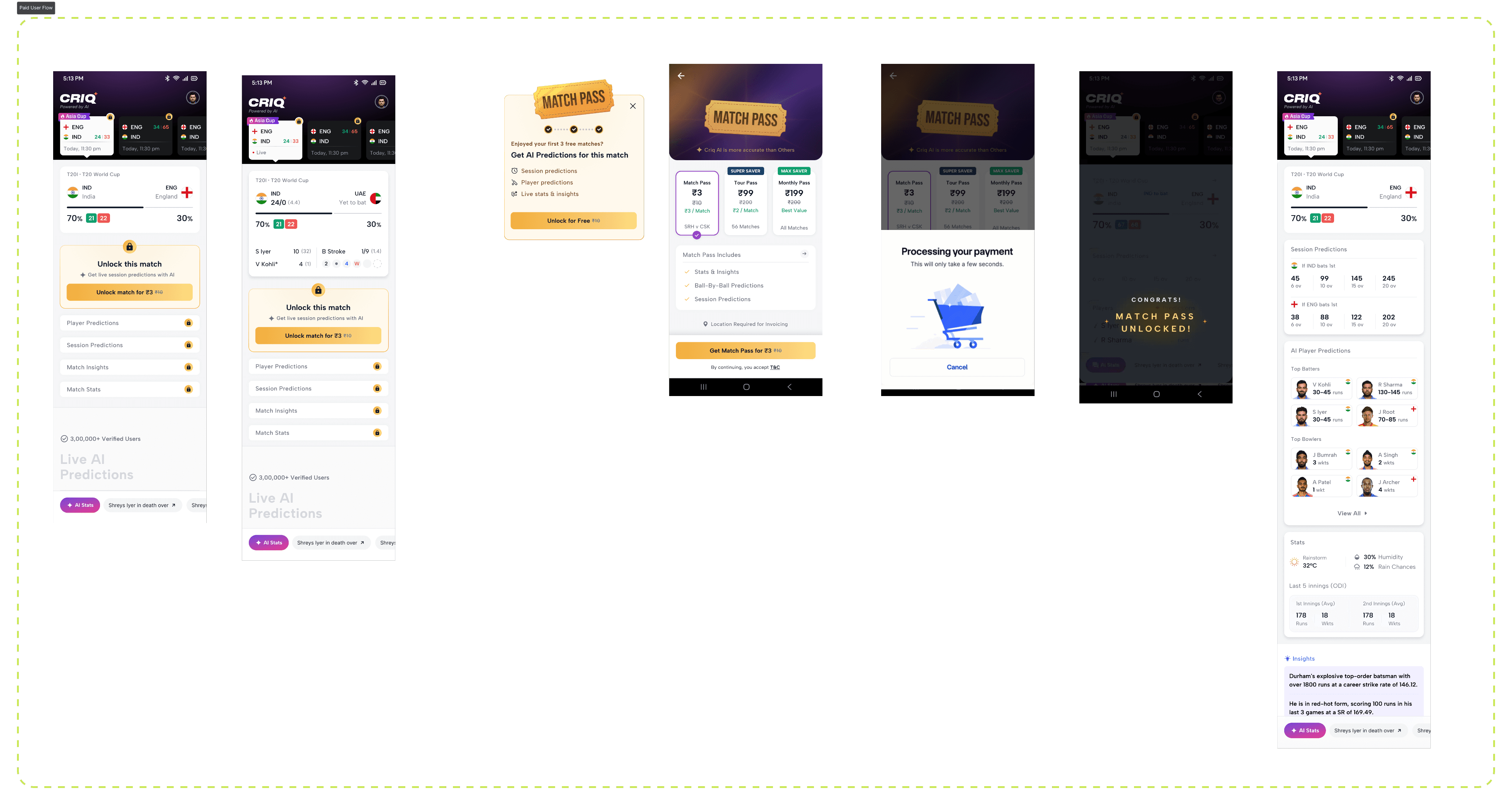
The redesign flipped this entirely.
Instead of blocking content, we showed it with strategic blurring on the highest-value AI insights. The "Unlock AI mode" CTA replaced the hard gate, appearing only after users had already seen enough to want more.
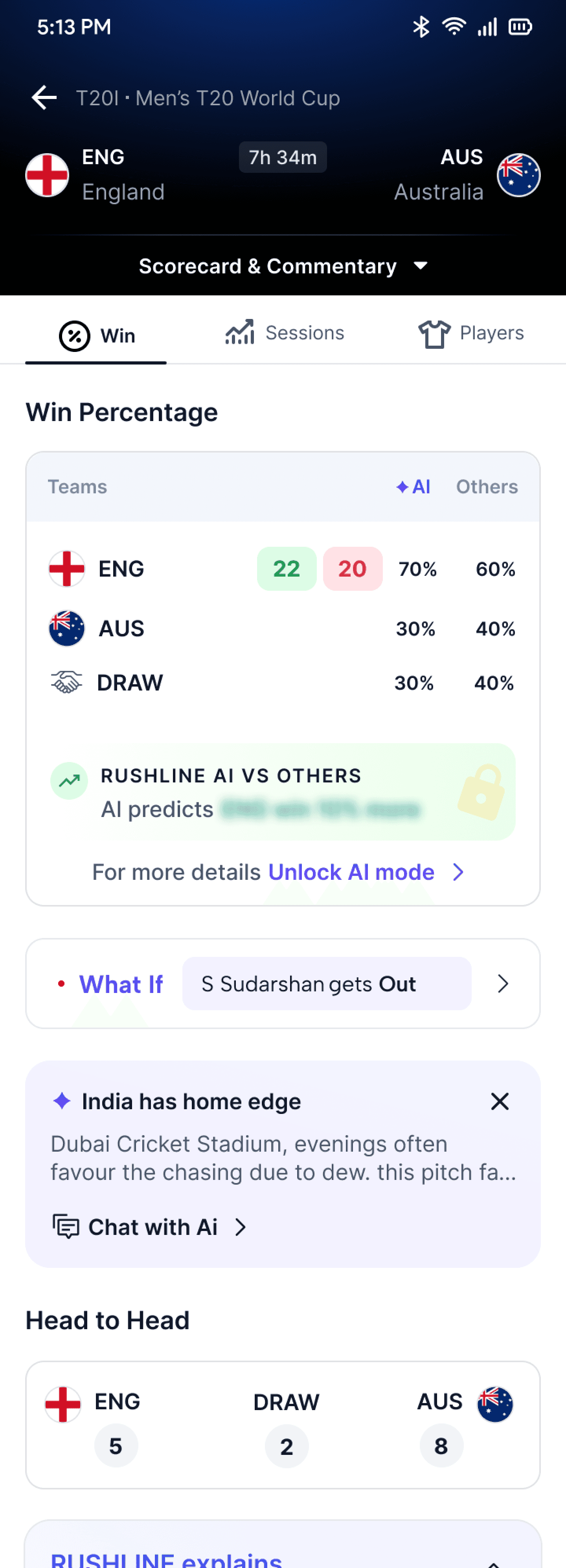
This pattern is rooted in the Endowment Effect. Once users had experienced the product's insight quality firsthand, converting felt like continuing rather than committing. We moved from a hard paywall to a soft paywall with value preview, and free trial conversion going from 2.1% to 6.8% validated the approach directly.
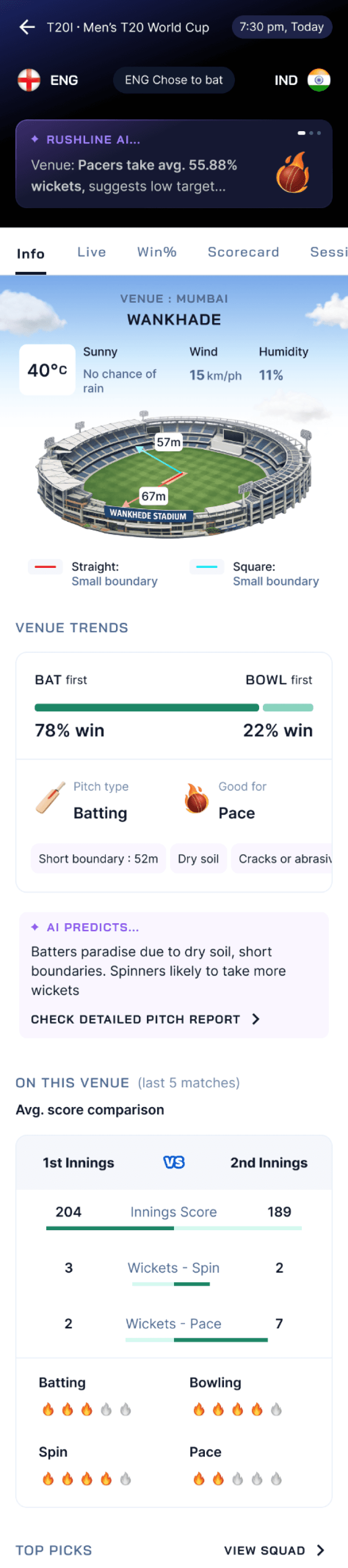
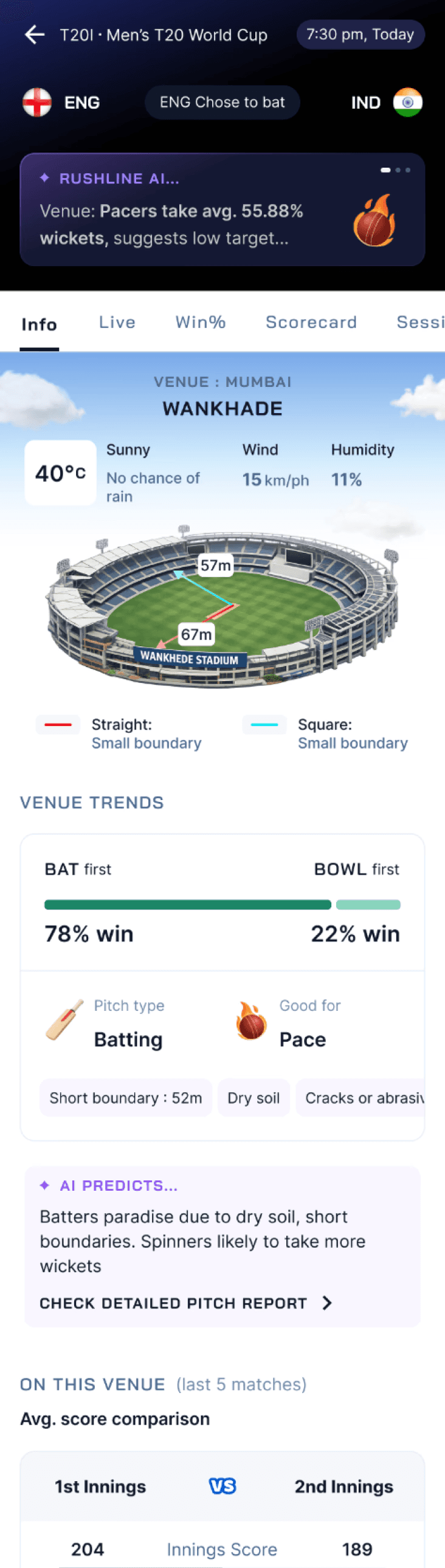
The Info page drove the strongest adoption jump in the product, with tab usage going from 8% to 53.6%. It was also the page that generated the most unprompted feedback, with teammates and stakeholders personally mentioning it as the standout screen in the product
The previous version was called "Winnings" and was probabilities-first: Win% front and centre, everything else secondary. Based on the new content-first direction that stakeholders approved, I redesigned it completely around what a sports investor actually needs to make a decision: venue context, pitch conditions, weather, historical trends, and AI insights, all layered in the right order.
OLD
NEW
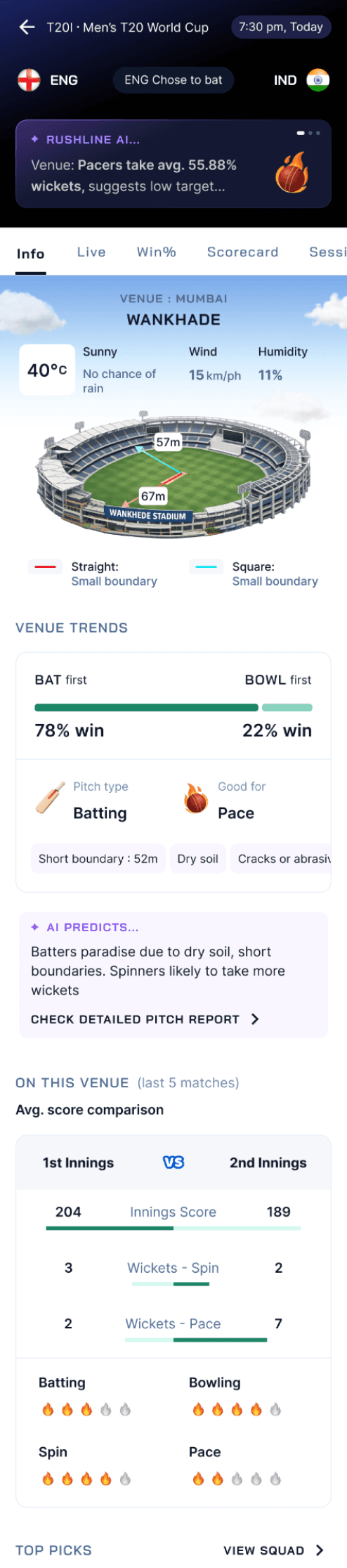
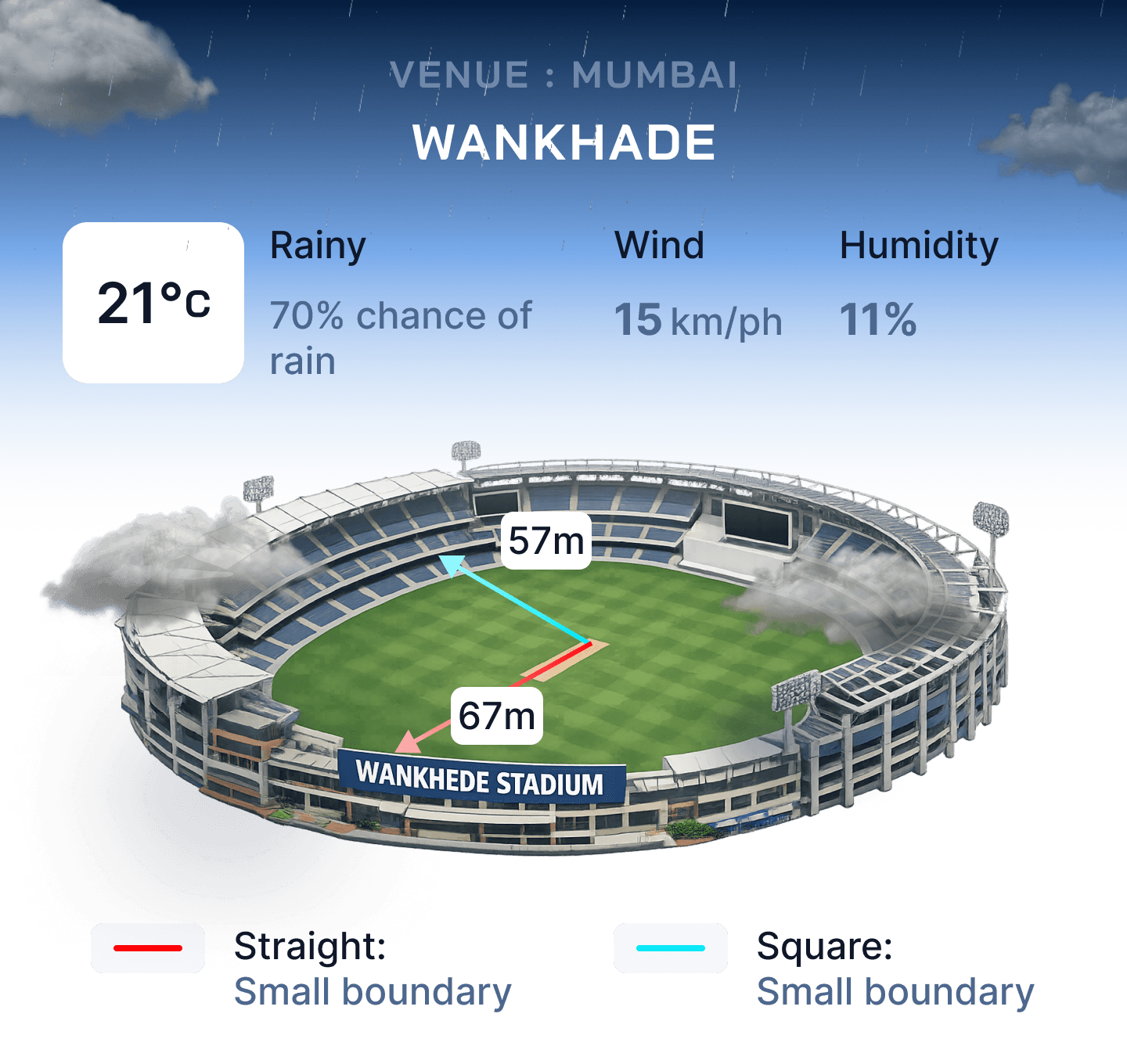
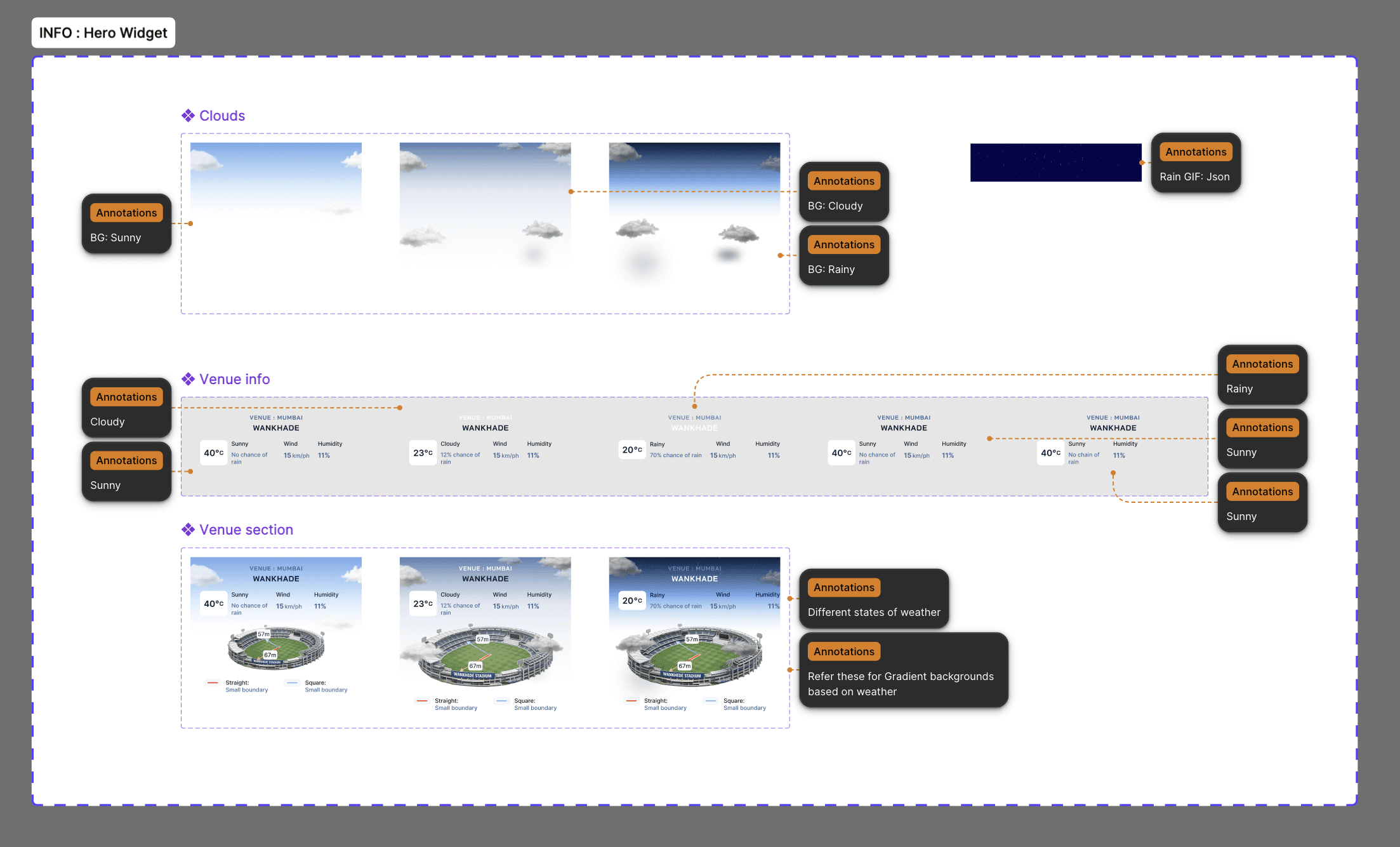
The standout design decision was the stadium visuals. Rather than using generic venue images, I built an AI generation pipeline:
I found a reference style on Pinterest that matched the product's visual direction. I used ChatGPT to engineer a precise generation prompt for isometric, top-view stadium illustrations with venue names. I used Gemini to generate the images and connected it to the Sports Interactive API so the correct stadium was generated dynamically for each match. The result was a unique, branded visual identity for every venue in the product.
I also designed 3 weather-state variations for each venue: sunny, cloudy, and rainy, with live animations. On rainy venues, rain fell in the background with animated clouds. These were not static screens. They responded to actual weather data.
Additional details I brought to this page: custom icons for pitch report categories, emoji-led data presentation to make dense stats feel approachable, and an AI Predicts section with full reasoning visible before the paywall.
For a product asking users to make financial decisions based on AI predictions, trust is not a feature. It is the foundation.
We built trust through two parallel approaches.
Social Proof:
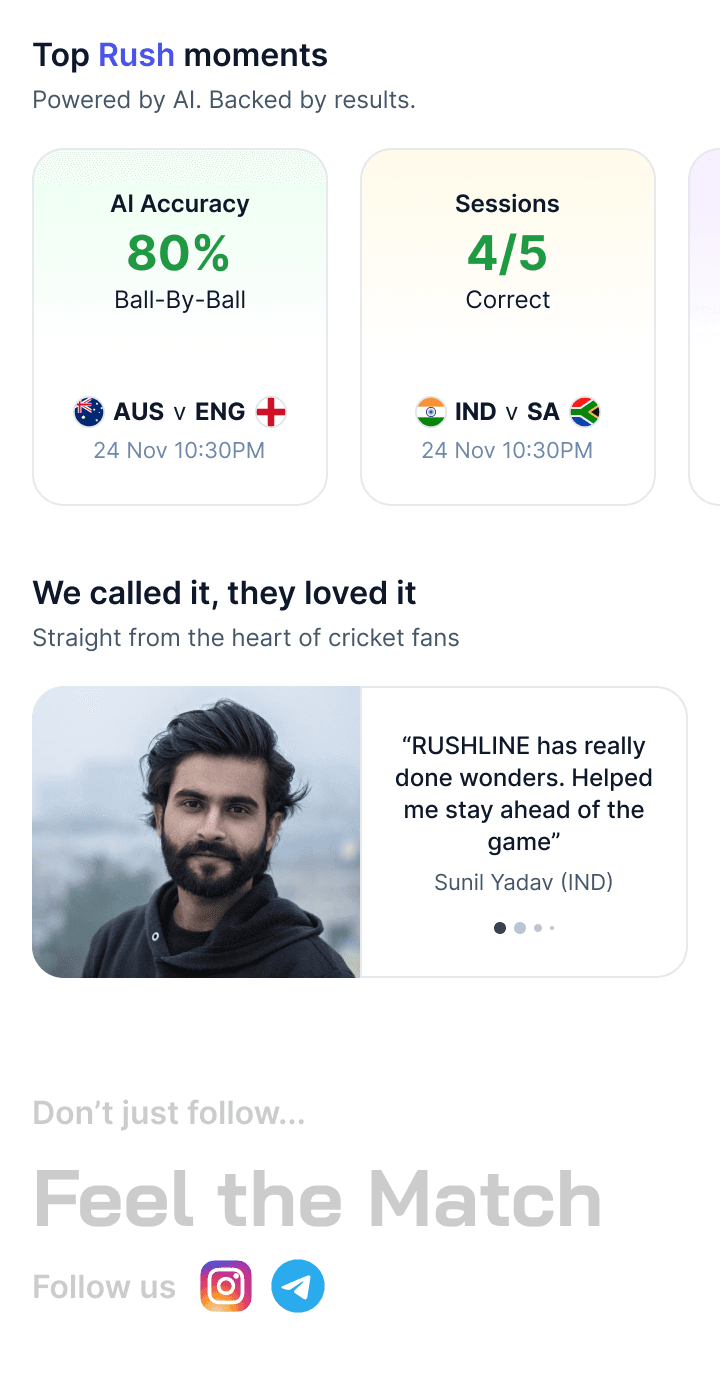
AI Accuracy displayed prominently: 80% Ball-By-Ball.
Sessions accuracy: 4/5 Correct.
Real user testimonials surfaced contextually.
"We called it, they loved it" with proof from actual cricket fans.
Contextual Explainability
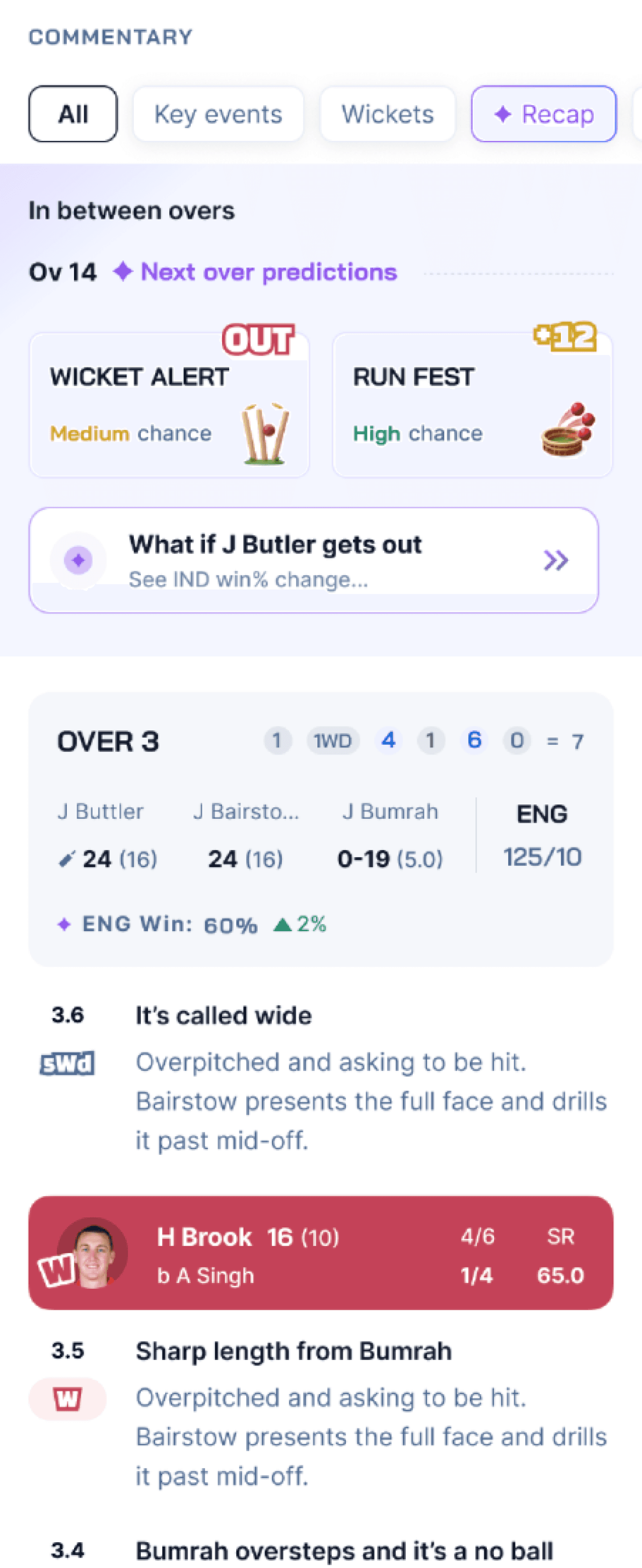
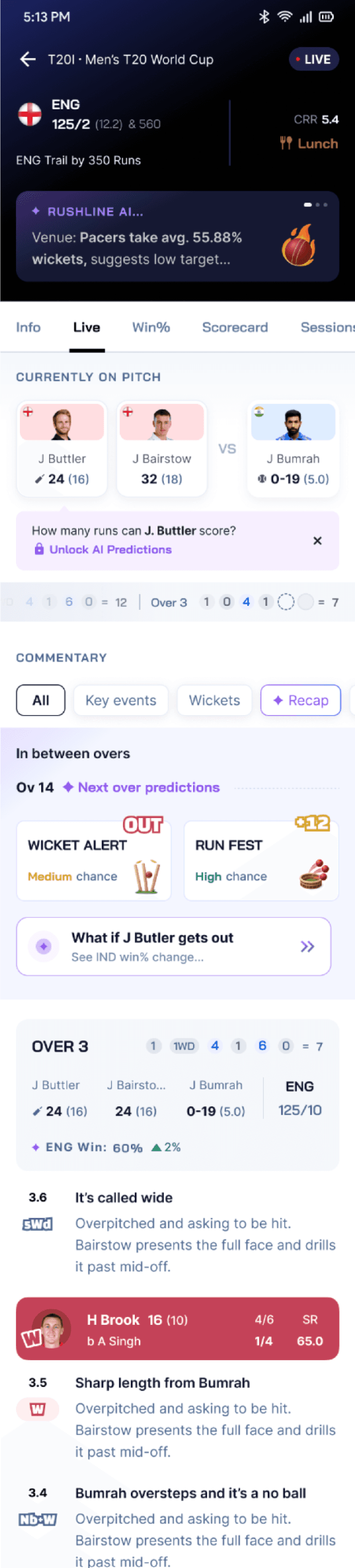
Every AI prediction came with its reasoning inline.
"Rushline explains: England on top, know why..." expanded on demand.
"What If" scenario planning, for example "What if Butler gets out?"
Run Fest and Wicket Alert overlays during live matches.
Venue Stats, Team Form, and H2H all surfaced at the right moment in the user journey.
The principle: users do not need to trust AI blindly. Show your working, show your accuracy, show real proof. Trust follows.
The original CRIQ direction was set with the assumption that sports investors already knew exactly what match they wanted and what data they needed. Based on this, the initial IA had no dedicated home screen. Users landed directly on the match detail page. In theory it made sense. In practice, user testing with the research team revealed that users were confused about how to navigate, could not orient themselves, and were dropping off before engaging with any data. DAU had dropped by 50% and over 40% of users took 4 or more days to even start a free trial.
This was the insight that justified the IA restructure. The product needed a home.
CRIQ showed everything at once: a dense wall of session predictions, player stats, and data tables with no hierarchy and no guidance. It was built for someone who already knew what they were looking for.
Before
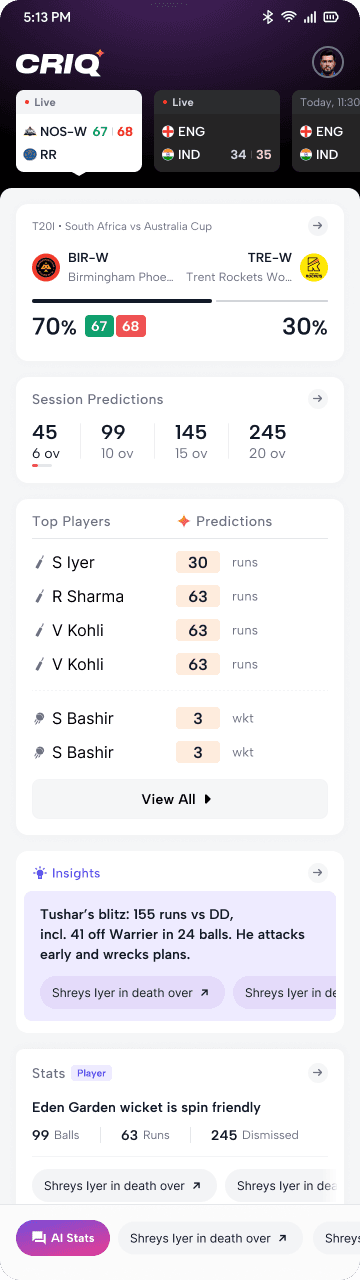
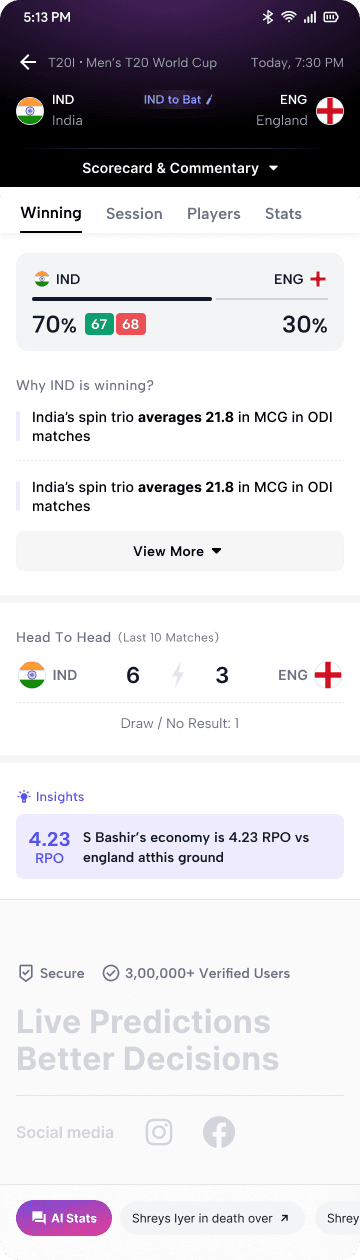
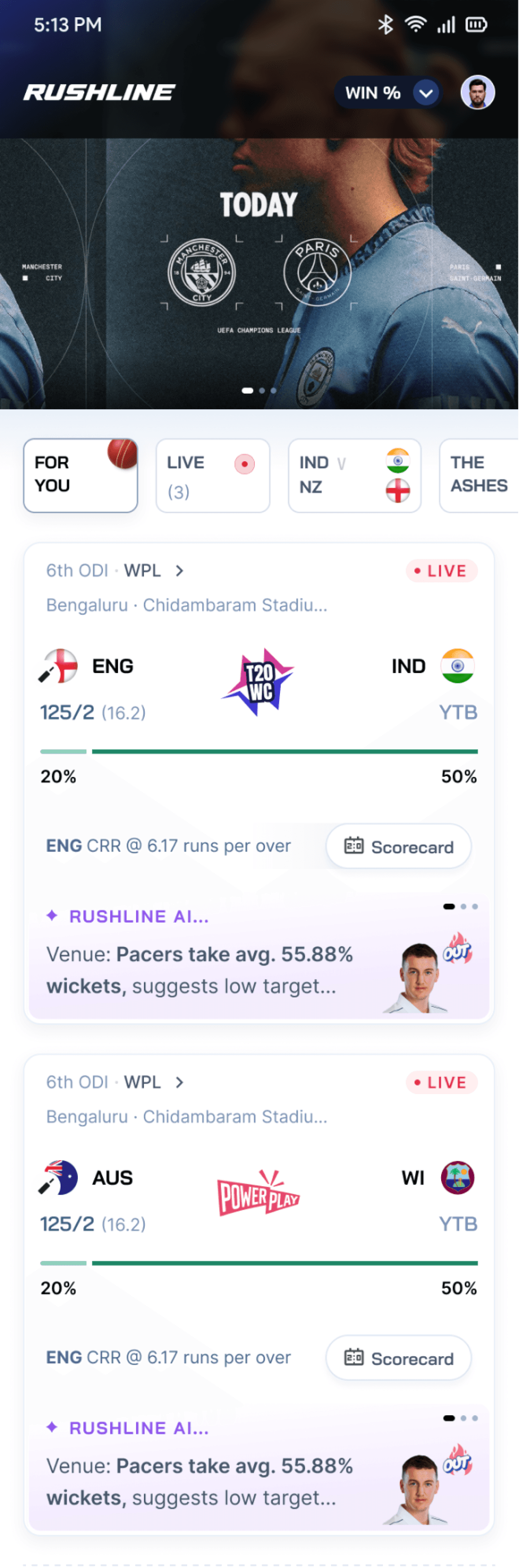
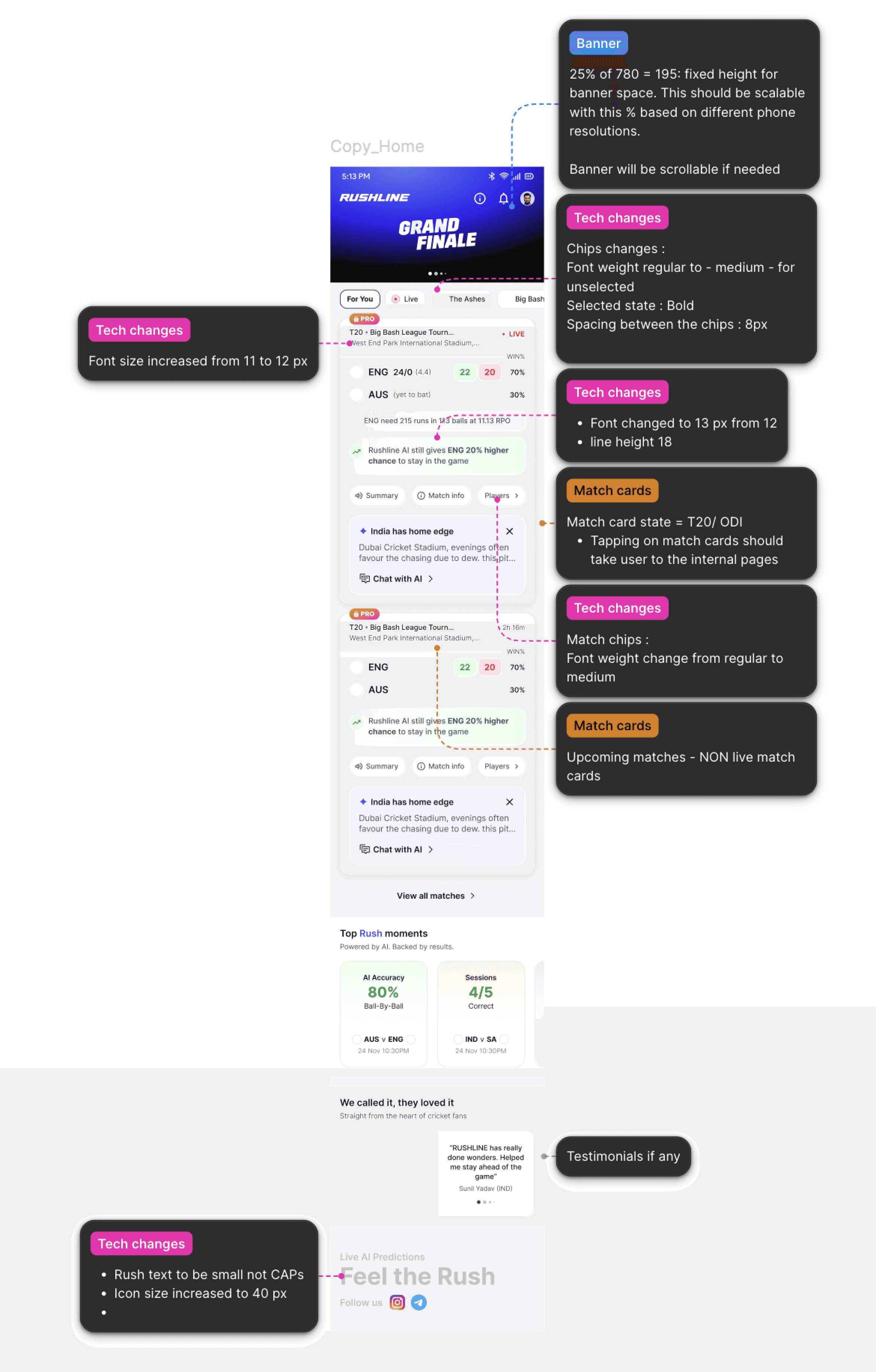
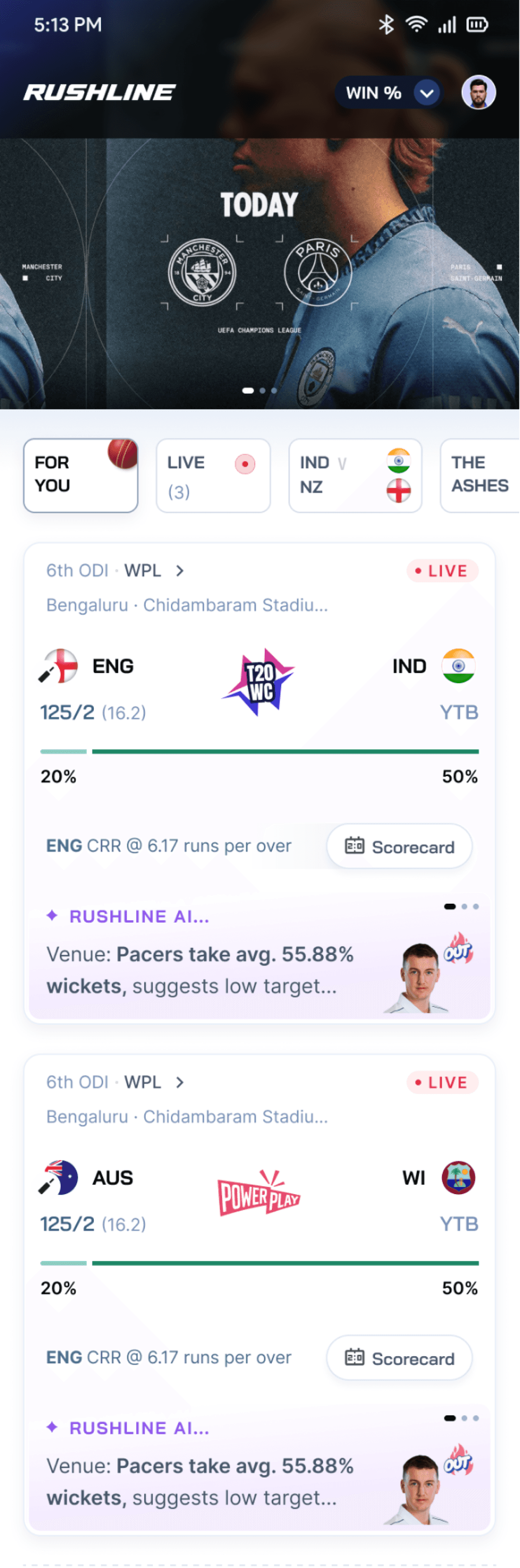
Rushline guided users through the decision. The home screen led with a branded hero, live match cards with inline AI callouts, and a clear visual hierarchy that surfaced what mattered most. The match detail screen layered information progressively: Win% first, then explainability, then deep stats for those who wanted them.
The product went from a data tool to a decision companion.
After
Rushline had been live for over a year before the IA restructure, but adoption remained low and the paywall strategy was not converting. After the redesign, the product showed significantly stronger promise, with session time doubling, free trial conversion tripling, and info tab adoption jumping from 8% to 53.6%
.
Despite the momentum, Rushline was shut down due to compliance and regulatory challenges around odds and betting-adjacent content in India, something entirely outside the design team's control. The metrics proved the design direction was right. The shutdown was a business and regulatory decision, not a product one.
The most expensive lesson from Rushline was the cost of unclear persona definition. Three major design pivots in 6 months, each individually well-executed, but the need to pivot at all came partly from the target user not being locked down early enough. If I were starting again, I would have pushed harder to validate the persona before the first line of IA was drawn.
The deeper lesson was about designing AI for trust. Users do not automatically trust AI predictions, especially when money is involved. Every decision, the explainability sections, the accuracy scores, the reasoning behind each prediction, was in service of one goal: making the AI feel like a knowledgeable friend, not a black box. That principle applies to any AI product regardless of domain.
The principle: users do not need to trust AI blindly. Show your working, show your accuracy, show real proof. Trust follows.